Monday, January 27, 2014

From manuscript to print

Have you seen this article about the book?  http://ilovetypography.com/2014/01/24/the-first-book-printed-in-italy    When looking at the page from this first printed book in Italy, we see examples from the manuscript tradition including a factotum (a letter in the blank spot at top left) that tells the illuminator or rubricator what letter to insert. In this case a C.

The blog post focuses on typography, that is typefaces, specifically those designed and created by Erhard Ratdolt (1442–1528), a Renaissance Typographer. He flourished in Venice where printing was an active and lucrative trade. The Heilbrunn Timeline of Art has an article about Ratdolt's printed work http://www.metmuseum.org/toah/works-of-art/17.45
  And you can find an example here http://www.metmuseum.org/toah/images/h2/h2_17.45.jpg

Careful examination of layout and design provide clues for how the page was composed and illustrations added. In Ratdolt's work, illustrations were either printed at the same type as the page using woodcuts that were colored later, or painted by hand afterward.

Ratdolt is most famous for printed work of Euclid http://www.sunsite.ubc.ca/DigitalMathArchive/Ratdolt/page1min.html There are not only beautiful borders framing three sides of the text, but also mathematical diagrams in the fore-edge margin, all printed at the same time.

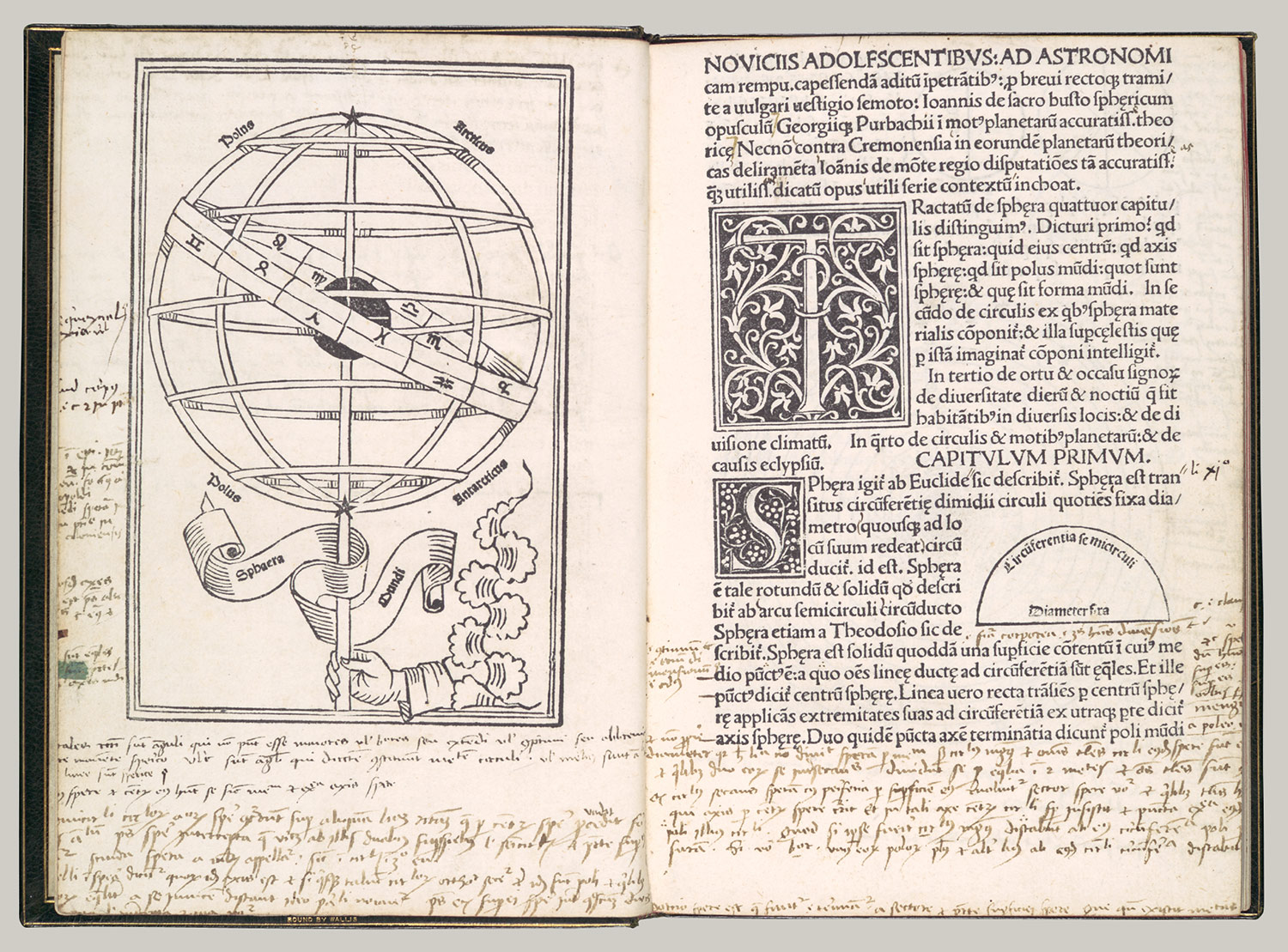
Here's an example of his printing where the illustrations have been colored in by hand. The caption from http://www.sunsite.ubc.ca/DigitalMathArchive/Ratdolt/ratvii.html reads "Schema zur Mondfinsternis. Holzschnitt, in drei Farben gedruckt, aus: Johannes de Sacro Bosco, Sphaericum opusculum, gedruckt von Erhard Ratdolt, Venedig 1485. Diagram, showing eclipse of the moon; woodcut, printed in three colours, from Sphaericum opusculum by Johannes de Sacro Bosco, printed by Erhard Ratdolt, Venice 1485." [To see a full size image of the page go to  http://www.sunsite.ubc.ca/DigitalMathArchive/Ratdolt/ratvii.html ]

For more information on Renaissance printers, check out "Typography & Graphic Design — Renaissance to Rococo Era" (History of Graphic Arts by Paula DiMarco, Ph.D., California State U Northridge course on typography) : http://www.csun.edu/~pjd77408/DrD/Art461/LecturesAll/Lectures/lecture03a.html

Wednesday, January 22, 2014

On overview of the history of books

Do you want to read more about the history of books? We will be reading some during the course of the semester. The main text by Chappell will provide an historical overview of texts and printing.

Martyn Lyons Books: A Living History (Los Angeles: The J.Paul Getty Museum, 2011) is an illustrated overview of the history of books from the earliest written texts (about 2000 BCE) to the present. Although he says he's covering the world, most of his examples are from the Western World. There are some examples from Asia and Arab countries which provide context for developments of movable type in Europe and for woodblock prints that prevalent in Asia. The photographs are lovely and set the book in context.

David Pearson's  Books as History: The Importance of Books Beyond Their Text (London & New Castle, DE: British Library & Oak Knoll Press, 2008, 2012) discusses how books fit in our lives and in the lives of our ancestors. Pearson takes readers beyond the text to consider why books are important.

If you are more interested in how the book changes over time, you should consult Frederick G. Kilgour   The Evolution of the Book (NY: Oxford University Press, 1998). Kilgour, of OCLC fame, describes how books evolve from the prehistoric period to the electronic book. Lacking color illustration, and indeed almost all illustration, this text focuses on the physical construction of books, their content, and markets.

To complement Chappell, you might look at S.H. Steinberg's  Five Hundred Years of Printing (London & New Castle, DE: British Library & Oak Knoll Press, 1955, 1996). Steinberg's expertise is printing, so he focuses on changes in type faces, layout, and design.

The newest book on the history of the book is a one volume work by Michael F. Suarez S.J. and H. R. Woudhuysen entitled The Book: A Global History (Oxford University Press, 2014). This work is a series of essays by scholars of the book covering every imaginable topic. Arranged chronologically and geographically, this book is perfect for the student and scholar who wants a thorough overview of scholarship of the field in the early 21st century.

There are many more books available on the history of the book from every imaginable perspective. I've selected a few from my favorites and my personal library. Let me know what your favorites are.

Monday, January 20, 2014

Project & Time Management

We are all busy. We have our own lives, jobs, school, and too many projects to let them all slide to the bottom of the pile or to the last minute. As an information profession, you will be expected to manage your time and projects. In addition to reference, cataloging, and bibliographic instruction, rare book and special collection librarians are expected to mount exhibitions of their materials. 

Exhibitions showcase special, rare, and unusual items within collections. In many cases, these exhibits market special collections and the wide range of materials, often hidden within the walls of the storage areas.  After selecting the subject of your exhibit, in the case of this course a specific author and work, you need to organize your project. Start with the date the finished project is due and work backward. For class, I've designed the project and have you delivering parts according to the schedule I've set. That's the project management aspect of the assignment. Your job is to budget your time accordingly so that the project gets finished on time and according to specifications. 

Managing a project is an important skill for all librarians and information scientists to master. In fact, it's an important skill for any job at any stage in your career. As a manager, you oversee your employees and direct reports to make certain the project has goals, objectives, and deadlines. Depending upon your management style, you may check on staff regularly to discuss problems that arise or just confirm that the project is on track. Master project management skills for yourself by setting short achievable deadlines that build upon one another. The key is time management. Set a time to do the work, remove all distractions, and complete that task. Check it off and set the next goal and deadline.  Before you know it, the project will be finished with time to spare.


Durer - the most amazing printer

There's a BBC radio program that discussesAlbrecht Dürer (1471–1528)
and his prints.  http://www.bbc.co.uk/i/b03q59w4/  The narrative is fascinating. If only the program included images of his work.  

The Metropolitan Museum of Art has a series of pages dedicated to his life and work http://www.metmuseum.org/toah/hd/durr/hd_durr.htm 

There's a house museum in Nurnberg dedicated to the artist http://museums.nuremberg.de/duerer-house/


The prints are so fine, fluid, and realistic. It seems as though the images could just walk off the page.  My favorites are the rabbit  and the rhinoceros. 

If you want to more about Durer, check out his website http://www.albrecht-durer.org/ 


Wednesday, January 15, 2014

Examining the minutiae

Studying texts involves examining the way books look and feel, how pages are designed and laid out, the arrangement of the text, collation of pages, and many other aspects, including book plates, signatures, and provenance. Now and again, researchers stumble upon books that look authentic but aren't. These cleverly created forgeries force librarians and scholars to scratch their heads and examine very carefully all the clues embedded in the book. The same is true for works of art that are later deemed forgeries.

This week, two articles crossed my desk that deal with forgeries. The first is Galileo's Sidereus  which a professor at Georgia State University studied and determined was a forgery. http://homer.gsu.edu/blogs/library/2012/09/26/gsu-faculty-member-uncovers-fake-book-sold-by-corrupt-library-director/    A longer article was published in the New Yorker (Dec 16, 2013) http://www.newyorker.com/reporting/2013/12/16/131216fa_fact_schmidle [Note, KSU provides access to the article through their catalog.] The scholars worked with Owen Gingrich, author of The Book Nobody Read: Chasing the Revolutions of Nicolaus Copernicus who studied most copies of Copernicus' work, examining marginalia. In the case of this Galileo forgery, they looked at library property marks, bibliographies, and other textual clues.

The second article is about the Oath of the Freedman. There's a short article about the forgery here:

Rare Book Crime Capers: Forgery, Theft, Murder and the Holy Grail of American Printing

These article discussion the study of type, layout, and typography to determine the forgery. 

Bibliography is all about the book. Look for clues as to their construction and pay attention to how they differ. This skill takes practice and requires attention to detail. Can you spot a reprint amongst the books you are studying?

Tuesday, January 07, 2014

Rothschild Prayerbook Set to Break Record - The Fine Books Blog

As we start to explore the world of rare and special books, it's important to read widely. There are a number of blogs that include information about rare books. Fine Books & Collections Magazine is one of those blogs. Today (January 7th, 2014), they posted this article about a Book of Hours that's to be sold at auction. 
Rothschild Prayerbook Set to Break Record - The Fine Books Blog
What's a Book of Hours you ask? It's a Christian devotional, a book for meditation and prayer that is mostly psalms  that was read by individuals throughout the day and week as the hours chimed in clock towers or prayers were chanted in monasteries and cathedrals. The finest Books of Hours were decorated with illuminated boarders and decorated capitals. We'll see examples of all of these in the Rare Books / History of the Book course this semester.

Two questions that may come to mind are "Why is this called the Rothschild Prayerbook?" and "Wasn't the family Jewish?" The answer to both questions is that the prayer book comes from the collection of the Rothschild Family and even if it wasn't most recently owned by them, they were the famous owner. Naming manuscripts and books is like naming archaeological artifacts, the object is given the name of the owner, the museum, the location, or the discoverer.

If you want to read more about Books of Hours, here's a link to an exhibit at the Houghton Library, Harvard entitled "Picturing Prayer" with beautiful examples of these prayer books. http://isites.harvard.edu/icb/icb.do?keyword=picturingprayer 
Enjoy

Tuesday, December 11, 2012

What a great semester

As the semester began, I was very nervous about teaching Rare Book / Special Collections Librarianship in an online venue. Now it is the end of the semester and I feel much more comfortable in this medium. While I still believe face to face classes are the best for learning complex subjects, each of you has gained experience studying the book, learning about the world of rare and special books, and even contemplated the future of these collections.  And I learned more about how to present materials in class. Believe me, there will be more visual examples and demonstrations next time.

There are some things I would change, for example, I would include more reference and bibliographic work asking you to examine websites, reference tools, and bibliographic sources more carefully. We would analyze their uses, their strengths and weaknesses, and even their flexibility. To help you focus, I will take real reference questions and have you work through them. In the end, these exercises will make you better, more efficient librarians, especially when dealing with reference, in person and virtual. 

The podcasts and exhibits are a resounding success, even if the website I selected has its drawbacks. Each and every one of you had the opportunity to study a book, think about the important aspects of that book and its various editions, and to create an exciting exhibition complete with podcast for others to explore.  Kudos to all!

Thank you for your contributions, discussions, news items, and more. Thanks for telling me about what you learned and how your concept and appreciation of the book changed throughout the semester. Most of all, thanks for participating.  For the quiet ones, you aren't forgotten, your contributions are important to me. 

As a final teaser, a book collector / dealer posted these Rhymed Rebuses http://www.simonbeattie.kattare.com/blog/archives/595  . Perhaps you'll be the one to solve them. 

Look for posts throughout the year as I come across interesting materials. You might also subscribe to my blog about cultural institutions http://mbkcons.blogspot.com/

Enjoy your holidays and semester break.

Monday, December 03, 2012

links from Penultimate Class videos

Rather than an extensive blog post, I thought I'd provide links to the various websites I show and talk about in my lectures this week. Today we most of the projects fall within the domain of "Digital Humanities" and should be, but often are not, collaborative projects between libraries, archives, museums, and academic disciplines including Art History, English, and History.

MAPS:


Photographs, moving images, and audio

Henschke Article about the Codex Sinaiticus
 Think about how we reproduce materials for subsequent scholarly use. Look at page 49, middle of the left column, we have a recitation of the various facsimiles created from the Codex. Notice the first is a lithographic copy of the leaves! http://en.wikipedia.org/wiki/File:Codex_Sinaiticus_Paralipomenon_9,27-10,11.JPG  This method of reproductions pre-dates microcards and microfilm by more than 50 years! They photographed the leaves, transferred the images onto stones and printed from the stones.  The article discusses the digitization project, it’s important to think about the mechanics of digitization and metadata, while considering how users will experience the output or finished project. 


Pre 2007 Digital Projects:
Contemporary digitization efforts.
Digitized classic texts 
Beowulf http://ebeowulf.uky.edu/ 
Romain de la Rose http://romandelarose.org/  

Some food for thought: How do these projects make rare books and special collections accessible to the general public and scholars?


Wednesday, November 28, 2012

vending books by machine - how convenient

A Book Vending Machine sounds like a novel idea. In fact, my first reaction, my first guess was that the machine was like the Book Expresso machine which prints books on demand. But this machine is definitely a vending machine.  Read the article and tell me what you think Book Vending Machines - The Fine Books Blog

Wednesday, November 21, 2012

Taking the time to think and explore

I want to follow up on David M Levy's article about thinking and reading slowly and thoroughly.

Levy has written extensively on the subject including Scrolling Forward: Making Sense of Documents in the Digital Age. David M Levy, in a longer discussion of the topic gives a Google Talk (58 minutes) entitled “No Time to Think” http://youtu.be/KHGcvj3JiGA  which expands upon this notion of being too busy, saturated, and distracted. One of the articles he brings up is Vannevar Bush's seminal work "As We May Think" Atlantic Monthly (July 1945)  http://www.theatlantic.com/magazine/archive/1945/07/as-we-may-think/303881/ In this article, Bush introduces the concept of hypertext, inter connection and speeding up thought. If you haven't read the article already, take the time to work through it and be amazed.

Information Overload is one of the overarching issues that prevents our taking the time to think, contemplate, and understand, to find quiet time to work. Ann Blair also writes about information overload in her 2011 book Too Much to Know: Managing Scholarly Information before the Modern Age
This is certainly  an issue all of us deal with as we attempt to master a subject. But in order to understand a subject, you must take the time to slow down, draw connections, synthesize, and think. One way to take the time to slow down is to practice 'serial mono-tasking.' Mono-tasking is doing one thing at a time, not jumping from thing to thing, topic to topic, following those maddening links while texting, talking, and watching YouTube.  By the way, Neil Postman writes about the issue of technology and how it dominates our lives in his 1993 book Technopoly: The Surrender of Culture to Technology.

If you are fascinated by this topic, you should check out this wonderful blog post by  Posted on by Simon Buckingham Shum "Complexity, Computing, Contemplation, Learning?" (May 4, 2011)
http://learningemergence.net/tag/contemplative-mind/ 

Take the time to slow down, relax, think, and engage with all of what you want to learn today.
 

Tuesday, November 13, 2012

Books about reading and books


There are books about books and publishing houses. Since Chappell [256-257] mentions Penguin Books, I thought you might enjoy looking at their history of the company http://www.penguin.co.uk/static/cs/uk/0/aboutus/aboutpenguin_companyhistory.html  and a history of the company "Penguin by Design: A Cover Story 1935-2005 " by Phil Baines  http://www.penguin.co.uk/nf/Book/BookDisplay/0,,9780713998399,00.html

At the same time, you might also enjoy reading about publishers who used different forms of printing, such as microprint. In this case, Oxford University Press which funded the Oxford English Dictionary (begun in 1857). While it had been printed in many formats and versions, and on a variety of media, the microprint edition (which they call Compact) is probably the most commonly found in homes. Here's an image of the page. Those who do own it, probably purchased it new through one of the many book clubs (that's how I purchased it), or used when someone moved and had to part with the amazing etymological dictionary. Today it is available online through its website or through a library. You can read about the history of the OED here http://public.oed.com/history-of-the-oed/   Notice that it was first printed in fascicles (gatherings) and distributed to libraries and subscribers. Remember how we looked at imposition by examining the Italian Ephigraphical dictionary when we met in September. If you are interested in reading about the OED's first editor James Augustus Murray, check out Caught in the Web of Words: James Murray and the Oxford English Dictionary by his granddaughter K.M. Elizabeth Murray or Simon Winchester's The Professor and the Madman: A Tale of Murder, Insanity, and the Making of the Oxford English Dictionary (P.S.). Both provide a fascinating view of the construction of large reference books, think Ann Blair.


I don't want to be distracted by the growth of the publishing industry or the creation of 'big books'. There are other articles and books that discuss the rise of reading, its importance in society, and proliferation in the 20th century. "Turning the Page" by Joan Acocella (New Yorker, Vol. 88 Issue 32 (Oct 15, 2012): 88-93) is a review article about women as readers throughout time. The article focuses on nineteenth century women readers, but provides an overview of the class of women who were literate in the Middle Ages and Early Modern Europe.

While you work on your exhibit about a specific book and author, think about the supporting materials that will bring your title and project to life in the eyes and minds of the viewer. You might highlight a publishers' binding or a special printing feature. 

For those of you who want to read more about publishers' bindings, view the website Publishers Bindings Online http://bindings.lib.ua.edu/

Friday, November 09, 2012

Modern Books

While I reviewed all the videos about how books are printed in the 20th century, I stumbled upon this gorgeous video about Wood Engraving. The artist is imitating and discussing Thomas Bewick's work carving on wood blocks so the designs can be printed at the same time as the text, that is in the same print run. 
Wait until you see the beautiful images he creates. Here's the link to the YouTube video entitled "Thomas Bewick and wood-block printing | Natural History Museum"   http://youtu.be/-2drmxm0wWo  

This second video really goes with the Encyclopaedia Britannic movie because it's a vocational film entitled "
History of Printing: Your Life Work"    http://www.youtube.com/watch?v=ss5soAuolks&feature=share&list=PL837E9D2803517413  . This film really describes all the various jobs of the printer. 

By now you are probably sick of  discussing printing or watching movies about the craft. So I have one more to share that looks at computers and us (how we use computers for conveying ideas)."The Machine is Us/ing Us (Final Version)" http://youtu.be/NLlGopyXT_g  

So what is the future of printing, publishing, and text? While the trade is more than 500 years old, computers and digitization are turning the field on its head and has been for many years now. Since we are still in the incunabula period of the web, of e-books, and of digital surrogates, we'll have to wait and see. The biggest question is will we recognize the revolution when it arrives or will be too caught up in the technology to notice. What do you think?

Tuesday, November 06, 2012

Printing and Typography: a feast for the eyes

I'm going to feed your fascination with type, typography, and printing with a number of viewing and reading suggestions. 

The Superintendent of Documents at the Government Printing Office suggested "The Linotype Film: In search of the eight wonder of the world" http://www.linotypefilm.com/
 or watch the video clips http://www.linotypefilm.com/clips.html
 and they have a great resources page http://www.linotypefilm.com/resources.html

For reading enjoyment you should check out Brenda Rickman Vantrease's The Heretic's Wife , all about printing and its suppression under Henry VIII. 

Allison suggested Stephen Coles and Tony Seddon's The Anatomy of Type: A Graphic Guide to 100 Typefaces (Harper Design, 2012). There is Simon Garfield's Just My Type: A Book About Fonts (Gotham, 2011) and Robert Bringhurst's The Elements of Typographic Style     (Hartley and Marks Publishers, 2004) coauthor of the Chappell book you are all enjoying.

If you want to read about identifying prints, check out Bamber Gascoigne's How to Identify Prints, Second Edition , an essential text for understanding how prints are made and identified. It even has close-up images for the curious. Of course you should have looked at IPI's Graphic Atlas http://www.graphicsatlas.org/
which allows viewers to look at prints and photographs in different types of light.

There are riches to behold when looking for information on prints and printing that I cannot do the subject justice. Check out the links on the syllabus and in the course session for more suggestions.


Wednesday, October 17, 2012

Care and Hanlding of Books

Preservation is a never ending challenge in libraries, especially in rare and special collections, archives, historical societies, and other cultural institutions. We need to think about the condition of materials before handing them to a researcher. Can we provide a surrogate or facsimile or is the original necessary for the researcher? What type of storage container does the item require? These are important questions to ask in special collections and for circulating collections.

Yale University Libraries just posted a 1980 slide show on YouTube http://youtu.be/3cLIhWprMq4 covering care, handling, shelving, and processing books in libraries. What's great is that it covers all the information you could possible want to share with your students and staff. Of course, clothing styles are lots of fun to look at also. (According to the text on YouTube under bullet 3, there is a pause of four seconds between each slide. Here is the link to the transcript : https://docs.google.com/open?id=0B1eGH1p97a4STXJTc3lOWFBEa2s .

I hope you enjoy this discussion of preservation, care & handling of books.

Tuesday, October 16, 2012

Digital Collections

Today I went to the Center for Jewish History http://www.cjh.org/ for the formal launch of the digital archives of the Leo Baeck Institute. http://www.lbi.org/digibaeck/ There's actually a video of the 2 hours of presentations. Brewster Kahle of the Internet Archive http://archive.org/ spoke about making the knowledge of the world freely accessible to everyone. Here's his TED Talk http://www.ted.com/talks/brewster_kahle_builds_a_free_digital_library.html
   where he talks about digitization, the book, and the idea of collecting all cultural materials of our societies. The talk here really duplicates what he talked about at the symposium.

The Leo Baeck Institute digitized 4000 linear feet of archives (all their collection) and made it freely accessible to the world. There are documents, translations and transliterations of materials. Photographs, videos, and sound recordings. Here's an example of an early printed book Augenspiegel (1509) that promotes printing in Hebrew http://digital.cjh.org/R/?func=dbin-jump-full&object_id=431433  What do you think about the viewer? the metadata? and the text itself?

I also learned a lot about how the Internet Archive and the Center for Jewish History are digitizing materials.  

Tell me what you think?

Oh yes, they have an amazing wall called "Luminous Manuscript" which imitates a page of glossed text. Here's the site http://www.cjh.org/p/89, (there's not great image of the wall on the site) and here's a link to the video about the wall http://www.cjh.org/programs/programarchives.php?vid=luminousmanuscript.flv   

All in all, a great experience. Tomorrow I'm off to Columbia University to see one of their rare book collections. I'll take photos and share.

Biblioclasts

Biblioclasts are a class in themselves when it comes to collectors and dealers. These are individuals who break apart books or sets of plates and sell them separately.  As we read in the article by Karen Edwards "Rip, Slash, and Tear: Can Plundering Books be a Form of Preservation?" Fine Books & Collections 5 no. 5 (Sept-Oct 2007): 44-49, biblioclasm is not rare. Book dealers do purchase books or sets of prints and break them apart to sell individually at a higher price. These legitimate dealers can be confused with thieves who take items from libraries and sell to unsuspecting dealers and collectors. Maps, prints, plates, and illuminations are all candidates for theft. The most famous being Gilbert Bland, map thief extraordinary who stole from libraries across the United States, the last being from the Peabody, as described by Miles Harvey in The Island of Lost Maps: A True Story of Cartographic Crime (NY: Broadway Books a division of Random House, 2001). Island of Lost Maps actually traces the history of map printing and theft through time, and the trial of Bland.

 The most famous biblioclast is Otto F. Ege (1888–1951) who was Dean of the Cleveland Institute of Art and collected medieval manuscripts. In a nutshell, he took the books apart, matted the leaves along with descriptions and sold them in portfolios to libraries and collectors around the world. Today, scholars are both studying the leaves Ege disbound, and are attempting to collate the leaves into books. Many of the university libraries that hold Ege leaves have digitized their collections and made them available on the web. Below is just a small sample of virtual exhibits and just two of the many articles about Ege and his amazing collections of leaves. 

Kent State University Special Collections has three sets of Ege leaves. There are others throughout the state, the country, and the world. Take a look at the leaves and at the articles to learn how scholars are piecing together these fragments.

Otto F. Ege Collection of Manuscript Leaf Portfolios at Dennison University, Granville, Ohio http://ege.denison.edu/index.php

Otto F.Ege Collection of Fifty Original Leaves from Medieval Manuscripts, Western Europe XII-XVI Century at University Libraries Digital Collections at the University of South Carolina http://library.sc.edu/digital/collections/ege.html

And at the University of Massachussets   http://www.library.umass.edu/spcoll/ead/mums570.html

Remaking the Book:Digitally Reconstructing the Otto Ege Manuscript Portfolios (June 13-14, 2005) University of Saskatchewan, Saskatoon  http://library2.usask.ca/ege/   

Stiocheff, Peter. "Putting Humpty Together Again: Otto Ege's Scattered Leaves." CHWP A. 42 (July 2008) http://projects.chass.utoronto.ca/chwp/CHC2007/Stoicheff/Stoicheff.htm 

Shailor,Barbara A."Otto Ege: His Manuscript Fragment Collection and the Opportunities Presented by Electronic Technology."The Journal of the Rutgers University Libraries 60 (2003): 1-22 http://reaper64.scc-net.rutgers.edu/journals/index.php/jrul/article/viewArticle/4


Of course, Ege's disbound leaves are not the only ones that scholars are reconstructing . There are many others in our collections. Most recently, Eric Johnson, Associate Curator of Rare Books at Ohio State University is endeavoring to collect all the dispersed leaves of the Hornby-Cockerell Bible. Here is a link to just three of the hundreds of leaves that OSU has collected. http://www.facebook.com/media/set/?set=a.526213757394922.135022.200441529972148&type=1

What do you think about biblioclasm?


Monday, October 15, 2012

Fragments and miscellaneous bits in books


When we look at early printed books, we often find materials are reused inside newer books. The Harry Ransom Center has a wonderful website that provides photographs of manuscripts bound into books. http://www.facebook.com/HarryRansomCenterFragments They also have images up on Flickr http://www.flickr.com/photos/ransom_center_fragments/ Some of the manuscripts are identifiable, others are not. Here's an example of a recycled manuscript that's in the collections at Ohio State University Rare Book Division http://www.facebook.com/media/set/?set=a.529393493743615.135790.200441529972148&type=1  If you are interested in what OSU Rare Book Librarians are up to, follow their Facebook page and blog http://www.facebook.com/RBMSatOSU?ref=ts&fref=ts

Aside from fragments of other books, we often find bits and pieces of materials in books. Sometimes there are dried leaves & flowers. Rare book librarians and conservators will encapsulate these herbal samples so they don't discolor the pages of the books more than they already have and so all the pieces and parts don't disintegrate. Geraldine Brooks' recent work People of the Book: A Novel describes the study of a book, all the extraneous parts, spills, stains, hairs, and more, as a conservator repairs the book and a librarian studies its history.

When conserving a book, repairing joints and reattaching boards, you'll want to retain the original parts. This is particularly important if the conservator replaces parts. Historians of the book will want to examine how the book looked before conservation treatments. Of course, you want the conservator to document the item before and after treatment for your own records. Here's an example of a cover (Amerbach Biblia Sacra at the American Bible Society) that shows damaged covers.


Here's an example of a spine that was repaired (left). It's actually a later binding (right) than the text within, which is a 1487 Hebrew Bible printed on vellum and held by the Dorot (Jewish) division at NYPL. 

No matter what, rare book curators and conservators want to document treatments, digitization, and miscellaneous pieces of books in catalog records and keep the parts together with the original text whenever possible.


Sunday, September 30, 2012

Gatherings or Quires

I know that we discussed format in class. There were a few lingering questions about imposition, signatures and collation. While I believe that you all know this by now, let me try to describe deciphering a gathering or signature one more time.

Let me see if I can explain the page and page numbers and gatherings so they make sense. Take three sheets of paper and fold them in half so they make a pamphlet. That's a GATHERING. Now, number each page on the bottom corner, RECTO and VERSO in order from 1 through 12. Now take them apart. Each sheet now consists of two leaves or four pages. The first sheet has page numbers 1,2,11,12, which could be signed A. When you COMPOSE the type (IMPOSE the pages) you have just printed those specific pages. Now you print the next sheet, A2 will contain page numbers 3,4, 9, 10 and sheet A3 will contain page numbers 5,6,7,8. 

The GATHERING of a FOLIO consists of sheets signed A,A2,A3 nested inside one another. Now you try it. 

When you have a book that's format is a QUARTO, that is a sheet folded twice to make 4 leaves or 8 pages, the imposition and pagination works in the same way as described above. If the gathering of a QUARTO has 16 pages, it is said to have gatherings of 16, that is two sheets nested inside one another. If there are 24 pages, then how many sheets are nested together?  

This practice becomes more difficult when your book's format is an OCTAVO or DUODECIMO. Consult MOXON or GASKELL if you want to learn the mechanics of imposition.

A Weekend Together

Wow! I'm so tired and happy about how our two day in-person session went. There was a good mix of lecture and hands on. All the materials I wanted to cover were at least touched upon and you had a chance to see rare books, special books, reference tools, and lots of bibliographies. 

More than anything else, this was a weekend to meet one another, learn from each other, and begin to build stronger working and collegial relationships. Now that you've all met, the discussion boards should be even livelier. I cannot wait to see the changes in your discussions and interactions with one another.

I hope you all feel this was a useful and productive weekend. Now you can relax, reflect, and think about what you learned and how you will use some of the new knowledge in your professional activities. I hope you recognize that some of the reference tools aren't in public libraries, but in academic libraries; that you may never learn about them again but should explore and examine every reference tool for its usefulness, contents, organization, and audience. Do that, and you are half way to mastering any subject.

The one subject we didn't really cover were the bibliographic databases of EBBO, ESTC, ISTC, and ECCO (Eighteenth century collection that incorporates or uses the Eighteenth Century Short Title Catalog). There are two sets of bibliographic tools for Nineteenth century literature and written materials. They are NCCO, the Nineteenth Century Collection Online http://info.library.okstate.edu/content.php?pid=210676&sid=2783437 and N I N E S, Nineteenth Century Scholarship Online http://www.nines.org/ They are slightly different in scope and use. While Kent State faculty and students don't have access to the resources on NCCO, we do have access to Nineteenth Century Literary Criticism, a Gale publication, through our library website.  These databases, along with the resources we discussed and specific website you discover will enhance your exhibitions and projects.

What did I take away from our two days in person? I better sense of who you all are, the importance of time for hands-on exercises, and an appreciation of how hard you are working. 

What else can I do for you to make the course better, stronger, clearer, or more useful? What can I do to enhance your learning experience and appreciation for the book? Send me e-mails, write me, let me know.

Until next time


Sunday, September 16, 2012

making paper

A number of you asked about making paper, designing font, and other technical aspects of the book.

I thought you would enjoy this video of students and apprentices at the University of Iowa Center for the Book making paper. http://www.youtube.com/watch?v=pEjZiPmRAV8&feature=share&list=PL837E9D2803517413   The video teaches the viewer that there were many steps needed to create paper that is used for printing on the hand press. Imagine how many sheets are needed for each book a printer made. First you have to calculate the number of copies, say 250. Then look at the manuscript to determine how many pages there are in the book, say 64. Now calculate how many pages fit on a sheet when you impose the book as a quarto or octavo (divide by either 8 or 16 - my math fails me here). Finally, you need to make extra sheets because there will be errors. And that's a short book. Now imagine a book of 300 pages. 

This second video describes how to make recycled paper on a continuous roll http://youtu.be/7SdJtYkAzTw

For those of you curious about how type is cast, you'll want to watch these videos from the Plantin-Moretus Museum in Holland part 1 http://youtu.be/dthT9thCOrM and part 2 http://youtu.be/L7ICWE3Qko8 and part 3 http://youtu.be/-BXeuhvhqS4
Watch the wrist action as the type caster forces the liquid into the mold. 

This 35 minute video describes how linotype is made and pages are composed. http://youtu.be/EzilaRwoMus This type of printing began in the late 19th century and continued until computerized printing in the early 1960s.

Please let me know if you find more visual examples or videos that explain how paper is made or type is case.